1. Overview
A disconnector (isolating switch) is a core switching device in power distribution, providing reliable isolation gaps between open contacts to protect personnel and equipment during maintenance, no-load switching and disconnecting operations. By voltage class: LV disconnectors (0.4 kV, mainly HR and GL series) and HV disconnectors (10 kV class, GN indoor and GW outdoor types); by mounting: indoor and outdoor; by function: plain isolating, with earthing blade, and motor-operated.
Heavy outdoor disconnectors rated above 10 kV (35 kV/110 kV class) are large units produced in small batches and are typically assembled at fixed workstations; this disconnector assembly line targets volume production of distribution-class disconnectors from 0.4 kV to 10 kV, where most downstream capacity sits.
Downstream sectors cover six main applications: distribution networks, commercial & industrial power supply, PV step-up circuits, wind box-type transformer packages, rail traction power, and mining/industrial plants. Renewable projects demand batch consistency and reliable switching operation; grid projects emphasize insulation withstand and long-term stability. A disconnector consists of four core subassemblies — base, post insulators, conductive blade and operating mechanism. With many loose parts and assembly steps, manual piece-by-piece transfer is inefficient and risks insulator chipping; a palletized roller conveyor line fits batch assembly well
.
2. Line Types and This Product
Disconnector assembly lines fall into three conveying types:
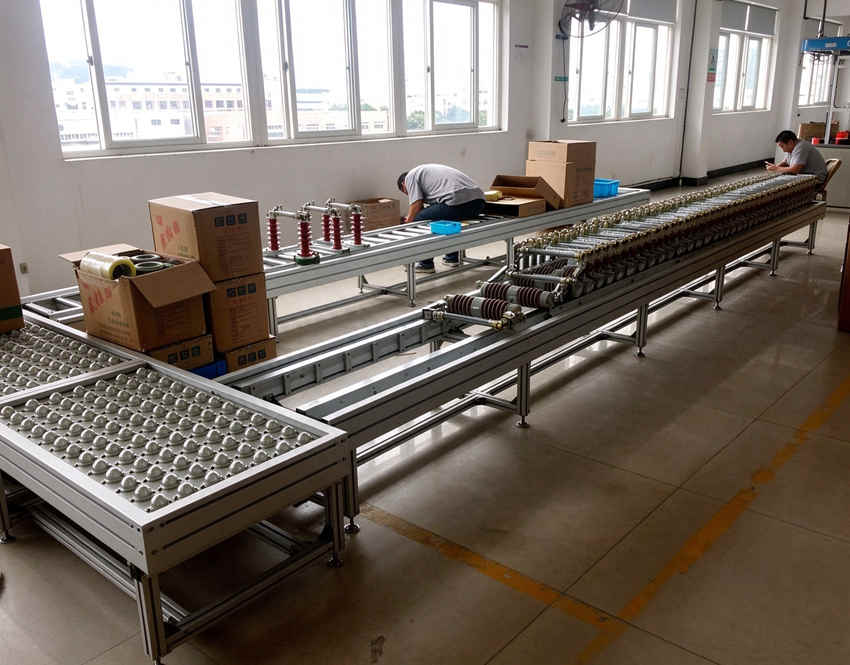
This line is an intermittent disconnector assembly & testing roller conveyor for batch production of indoor/outdoor disconnectors rated 0.4 kV–10 kV. Workpieces travel station to station on work pallets, with assembly stations, electrical testing stations, ball-transfer diverting stations and a return line, covering base assembly, insulator fitting, conductive-circuit adjustment, electrical testing and packaging. The modular frame allows flexible station configuration, solving manual material handling, takt imbalance and missing traceability, and is planned for tens of thousands of units per year (output per customer takt).
3. Assembly Process
The line covers all operations from base loading to finished packaging in a station-based discrete assembly mode:
Universal ball transfer tables (ball tables) enable 90° turning, multi-line merging and diverting for parallel station work. The frame is built of industrial aluminum profile — clean and burr-free, suitable for electrical component assembly. Mechanical stoppers locate each station, keeping workpieces stable during assembly and meeting mechanical accuracy and electrical performance requirements
.
4. Customizable Parameters
The following parameters are tailored specifically for disconnector assembly scenarios, designed around different voltage classes and structures — not generic conveyor specifications.
表格
| No. | Parameter | Standard Config | Custom Range | Disconnector-Specific Note |
|---|---|---|---|---|
| 1 | Operation mode | Powered rollers + pallets, intermittent conveying | Continuous / intermittent indexing | Intermittent + station stopper recommended for precision assembly; avoids impact damage to insulators |
| 2 | Rated load per station | 150 kg | 50–500 kg | Selected by target disconnector weight, covering 0.4 kV–10 kV mainstream models; large outdoor units above 10 kV excluded |
| 3 | Roller spec | Φ50 mm galvanized carbon steel | Φ38/50/60 mm, aluminum/carbon steel | Smooth surface, stable pallet conveying, avoids chipping porcelain insulators |
| 4 | Roller pitch | 120 mm | 100–150 mm | Larger pitch for small units; smaller pitch for heavy models to support pallet rigidity |
| 5 | Conveying speed | 8 m/min | 3–15 m/min VFD | Low speed at assembly stations for safety; higher speed on buffer/return sections |
| 6 | Work pallet | 1200 × 800 mm | Custom, up to 2000 × 1200 mm | ESD-grade PVC or bakelite pallet with locating fixtures for different base sizes |
| 7 | Drive | Sectional gear motor + sprocket | Motorized rollers / timing belt | Sectional drive lowers noise for clean assembly shops |
| 8 | Stations | Loading, insulator, blade, mechanism, testing, packaging, return (7 types) | Add/remove stations, lift & rotate units, ball-transfer diverting, rework station | Test station integrates withstand/contact resistance test interfaces for in-line testing |
| 9 | Positioning accuracy | ±2 mm | ±1–±5 mm | Mechanical stopper + photoelectric double locating for test and assembly stations |
| 10 | Control system | PLC + HMI, MES-ready | Profinet / Modbus TCP | Work-order scanning, torque data upload, test result traceability |
| 11 | Frame material | Industrial aluminum profile, anodized | Carbon steel painted / stainless steel | Standard lightweight clean design; carbon steel frame for heavy-duty versions |
| 12 | Safety | E-stops, light curtains, running indicators | Safety fencing, door locks, ESD grounding | HV safety interlock at testing stations |
| 13 | Ambient temperature | 5–40 °C | −10–50 °C version | Standard for normal shops; dedicated motors and controls for cold/hot shops |
| 14 | Line length | Per layout | 10–60 m per line | Sectional control, phased expansion for capacity growth |
5. Supplementary Notes
This line is custom-designed for disconnectors: the priority is assembly accuracy, smooth running and ESD protection rather than high-speed conveying. With porcelain/composite insulators and precision contacts, impact, chipping and electrostatic damage must be avoided during conveying and assembly — hence soft start/soft stop control, closely spaced rollers and ESD-grade work pallets protect product quality from the conveying stage.
The line is highly flexible: by changing locating fixtures, one line handles disconnectors of different voltage classes and structures in mixed production, covering multi-model, batch and small-batch scheduling. The modular design supports later station extension and test-equipment integration, lowering line upgrade cost.
Note: all parameters above are reference standard values with customizable ranges; the line is non-standard custom equipment — final design follows your actual scheme.
Previous: transformer assembly lin...
Next: No more results